
TL;DR:
- Proactive talent sourcing involves building relationships with passive LATAM marketing candidates long before roles open.
- Effective sourcing uses personalized outreach, targeted channels, and regional understanding to create reliable talent pipelines.
- Most agencies fail by relying on reactive recruiting, missing out on high-quality candidates and faster hiring.
Most marketing agency owners think hiring starts when they post a job. The best ones know it started months ago. While your competitors are refreshing their inboxes waiting for resumes, top-performing agencies are quietly building relationships with skilled marketers in Latin America who haven’t even updated their LinkedIn profiles yet. That gap, between reactive posting and proactive sourcing, is what separates agencies that scramble to fill roles from those that hire fast, hire well, and retain longer. This guide breaks down exactly what talent sourcing is, how it works, and how you can use it to build a reliable pipeline of remote marketing talent from LATAM.
Table of Contents
- Defining talent sourcing vs. traditional recruiting
- The framework: Key steps in effective talent sourcing
- Sourcing strategies for remote marketing talent in Latin America
- Building and maintaining a high-quality marketing talent pipeline
- What most agencies get wrong about talent sourcing
- Take your next step: Expert help for sourcing LATAM marketing talent
- Frequently asked questions
Key Takeaways
| Point | Details |
|---|---|
| Proactive sourcing works best | Agencies succeed faster when they build marketing talent pipelines early, not just when jobs open. |
| Follow structured frameworks | Using stepwise sourcing methods improves your odds of finding high-caliber remote talent. |
| Tailor strategies for LATAM | Understanding Latin American culture and channels delivers better sourcing results for U.S. agencies. |
| Candidate relationships matter | Long-term engagement with top talent gives you an edge over competitors who only recruit reactively. |
Defining talent sourcing vs. traditional recruiting
Let’s clear up the confusion right away. Most people use “sourcing” and “recruiting” interchangeably. They are not the same thing, and mixing them up costs agencies time, money, and good hires.
Talent sourcing is the proactive process of identifying, engaging, and building relationships with potential candidates, particularly passive ones, to create talent pipelines for current and future roles. Recruiting, by contrast, is reactive. It kicks in after a role opens, after you’ve already lost momentum.
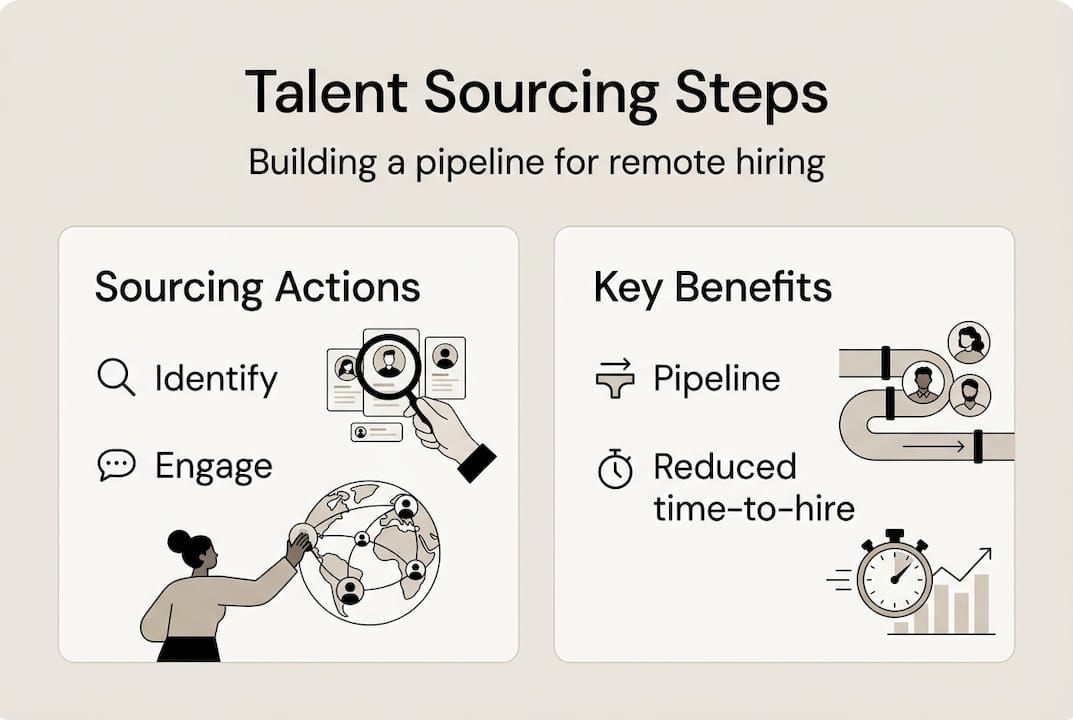
Think of it this way: recruiting is fishing when you’re hungry. Sourcing is stocking the pond all year so you always have something to catch.
Here’s a side-by-side comparison to make the difference concrete:
| Factor | Talent sourcing | Traditional recruiting |
|---|---|---|
| Timing | Ongoing, before roles open | Starts when a role opens |
| Candidate type | Active and passive candidates | Mostly active job seekers |
| Goal | Build a long-term pipeline | Fill a specific open role |
| Approach | Proactive outreach and nurturing | Inbound applications and screening |
| Speed to hire | Faster (pipeline already exists) | Slower (starts from scratch) |
For U.S. marketing agencies, this distinction is critical. When a key PPC specialist or SEO lead leaves, you can’t afford a 6-week hiring cycle. You need a warm bench of pre-vetted candidates ready to move.
“The agencies that consistently hire well aren’t lucky. They’ve been building relationships with talented marketers long before they had an open seat.”
That’s exactly why optimizing remote marketing hiring requires a sourcing-first mindset, not a job-board-first one. When you source talent from LATAM proactively, you’re not just filling roles faster. You’re building a funnel of qualified professionals who already know your agency’s culture and expectations before day one.
Passive candidates, those not actively job hunting, often represent the strongest talent pool. They’re employed, skilled, and not desperate. Reaching them requires outreach, relationship building, and trust. That’s sourcing.

The framework: Key steps in effective talent sourcing
With the distinction clear, let’s walk through a proven process you can follow for sourcing remote marketing talent. The core mechanics of an effective sourcing process follow a logical sequence that most agencies skip entirely.
A widely used model breaks the process into these steps, drawn from sourcing strategies frameworks used by talent acquisition professionals:
- Analyze talent needs and build job personas. Before searching, define what you actually need. Not just a job title, but attributes: communication style, tool proficiency, time zone availability, and work independence level.
- Map your sourcing channels. LinkedIn, referrals, Boolean and X-Ray searches, ATS mining, and specialist communities are all valid channels. Each works differently depending on the role.
- Execute personalized outreach. Generic messages get ignored. Personalized messages that reference a candidate’s specific work get responses. Volume matters, but relevance matters more.
- Qualify through initial screening. A short call or async assessment filters candidates early so you’re not wasting time on poor fits.
- Nurture candidates into your pipeline. Not every great candidate is ready to move now. Stay in touch, share relevant content, and keep the relationship warm.
- Measure and improve. Track response rates, conversion from outreach to interview, and time-to-hire. These numbers tell you where your funnel leaks.
Here’s a quick look at what good pipeline metrics look like for a marketing role:
| Metric | Healthy benchmark |
|---|---|
| Outreach response rate | 20 to 35% |
| Outreach to interview conversion | 10 to 20% |
| Interview to offer conversion | 25 to 40% |
| Time to fill (with pipeline) | 7 to 14 days |
Addressing talent challenges proactively means having these metrics tracked before you’re under pressure to hire.
Pro Tip: Attribute-based search consistently outperforms keyword search for marketing roles. Instead of searching “SEO manager,” search for candidates with specific tool experience (Ahrefs, Screaming Frog), client types (e-commerce, SaaS), and measurable outcomes (traffic growth, ranking improvements). You’ll find stronger candidates with less competition for their attention.
The agencies that optimize their remote marketing teams treat sourcing like a marketing campaign. They test messaging, track conversions, and iterate continuously.
Sourcing strategies for remote marketing talent in Latin America
Once the core framework is established, let’s focus on what makes sourcing in Latin America unique and how to avoid common pitfalls. LATAM is not a monolithic talent market. Brazil, Mexico, Colombia, Argentina, and other countries each have distinct professional cultures, platform preferences, and career motivations.
For U.S. marketing agencies, the most effective LATAM hiring strategies involve mapping channels carefully before outreach. Here’s what works:
- LinkedIn remains the strongest channel for mid-to-senior marketing professionals across LATAM, especially in Colombia, Mexico, and Argentina.
- Referral networks are highly effective in LATAM cultures where professional trust is built through relationships, not cold applications.
- Specialist communities (Slack groups, Discord servers, regional marketing forums) surface candidates who are actively engaged in their craft.
- ATS mining from past applicants is often overlooked but can yield strong candidates who were previously a close second.
Screening for remote-readiness is non-negotiable. Strong LATAM candidates should demonstrate reliable internet infrastructure, async communication skills, and experience working with U.S.-based teams or clients. Time zone alignment with Eastern Time is a practical filter that saves friction later.
Cultural fit for remote teams goes beyond language fluency. It includes communication directness, feedback receptiveness, and comfort with U.S. work rhythms. These are soft skills that need to be assessed in sourcing conversations, not just during formal interviews.
Pro Tip: Many U.S. agencies assume LATAM candidates are motivated primarily by salary. In reality, career growth, mentorship, and long-term stability often rank higher. Candidates who feel they’re joining a team that invests in them stay longer and perform better. Build that message into your outreach from the start.
Nurturing LATAM candidates requires cultural sensitivity. A follow-up message that feels pushy in a U.S. context might be completely appropriate in another. Learn the norms for each region you source from. Explore proven LATAM remote team strategies to understand how successful agencies have navigated this.
Building and maintaining a high-quality marketing talent pipeline
With regional best practices in mind, here’s how to turn your sourcing process into a scalable, evergreen marketing talent pipeline. A pipeline is only valuable if it’s maintained. A list of contacts you haven’t spoken to in eight months is not a pipeline. It’s a graveyard.
Building long-term pipelines means treating sourcing as a relationship discipline, not a transactional task. Here’s a practical approach:
- Segment your candidates. Group them by role type (PPC, SEO, content, design), seniority, availability timeline, and region. This makes activation fast when a role opens.
- Set a contact cadence. Touch base with warm candidates every 6 to 8 weeks. Share a relevant article, congratulate a career milestone, or simply check in. Keep it natural, not salesy.
- Use a simple CRM or ATS. Even a well-organized spreadsheet beats nothing. Tools like Notion, Airtable, or a basic ATS let smaller agencies track outreach history, notes, and candidate status without enterprise-level complexity.
- Respond fast when roles open. A warm pipeline only pays off if you act quickly. Candidates who hear from you within 24 to 48 hours of a role opening feel valued and are far more likely to engage.
Here are the key habits that separate agencies with strong pipelines from those that always start from zero:
- Review and update pipeline segments monthly
- Log every touchpoint, even brief ones
- Ask current LATAM hires for referrals consistently
- Track which channels produce the best long-term hires, not just the fastest responses
Exploring best outsourcing practices can also sharpen how you structure these relationships. And if you want proof that this approach works, real agency success stories show exactly what a well-built LATAM pipeline looks like in practice.
The payoff is real: agencies with active pipelines cut their average time-to-hire significantly and reduce the desperation-driven hiring mistakes that hurt team culture and client delivery.
What most agencies get wrong about talent sourcing
Here’s the uncomfortable truth: most agencies treat sourcing as something you do when you’re desperate. A role opens, panic sets in, and suddenly everyone’s posting on job boards and hoping for the best. That’s not sourcing. That’s firefighting.
Real sourcing is a year-round discipline. The agencies that build the strongest remote marketing teams in LATAM are the ones doing proactive talent headhunting even when they have no open roles. They’re building trust with candidates who may not be available for three months. They’re staying visible in communities where strong marketers spend their time.
The other mistake we see constantly is over-relying on resumes. A resume tells you what someone has done. It tells you almost nothing about how they communicate, how they handle feedback, or whether they’ll thrive in your agency’s specific environment. Sourcing done right surfaces those signals early, through real conversations, not paper screening.
Nurturing pipelines also builds agency resilience. When you have warm candidates ready, you’re not at the mercy of the job market. You make better decisions, move faster, and avoid settling for a candidate who’s just available rather than genuinely right.
Take your next step: Expert help for sourcing LATAM marketing talent
If you’re ready to accelerate your sourcing or want expert backup, here’s where to go next.
Building a proactive talent pipeline takes time, structure, and deep regional knowledge. If your agency doesn’t have a dedicated sourcing function, you’re likely leaving strong LATAM marketing talent on the table.
Remote Talent LATAM specializes in exactly this work. Our remote LATAM headhunting process reaches hundreds of candidates per role, vets them rigorously, and delivers a curated shortlist in 7 to 10 business days. You only pay if you hire. If you want to see what’s possible, explore practical tips for hiring remote LATAM talent or get started today to connect with our team directly.
Frequently asked questions
How is talent sourcing different from traditional recruiting?
Talent sourcing is proactive and builds pipelines of candidates before jobs are open, while recruiting usually starts only when a position needs filling. Sourcing targets passive candidates; recruiting mostly handles active applicants.
Why is sourcing remote marketing talent from Latin America effective?
LATAM offers qualified marketing professionals with strong cost, time zone, and cultural advantages for U.S. agencies. Mapping sourcing channels like LinkedIn and referrals in the region consistently surfaces high-quality candidates aligned with U.S. work expectations.
What tools help agencies build effective talent pipelines?
Popular tools include LinkedIn, referral programs, applicant tracking systems, and simple CRM databases for candidate outreach and management. Boolean and X-Ray searches through LinkedIn and Google also surface strong passive candidates that job boards miss entirely.
What’s the biggest mistake agencies make with talent sourcing?
Agencies often wait for candidates to apply instead of actively building relationships with potential hires. Building long-term pipelines before roles open is what separates fast-hiring agencies from those that scramble every time a seat goes empty.
Recommended
- Talent Headhunting: Source Skilled Remote LATAM Pros Fast
- A Comprehensive Guide To Hiring Remote Workers | Remote Talent LATAM
- LATAM Hiring Success Stories | Client Results & Case Studies
- 4 Characteristics Of The Best Remote Recruiting Companies | Remote Talent LATAM