TL;DR:
- Latin American talent offers overlapping timezones and cultural alignment with U.S. teams.
- A structured recruitment process and proactive sourcing ensure high-quality, long-term LATAM hires.
- Investing in onboarding, communication, and retention strategies boosts long-term remote team success.
Plenty of marketing agency owners have passed on Latin American talent because of old assumptions: spotty internet, communication gaps, or unreliable work schedules. Those assumptions are costing agencies real money. The market has shifted dramatically, and agencies still running outdated hiring playbooks are watching competitors build leaner, faster, more capable teams at a fraction of the cost. This guide breaks down exactly how to recruit, vet, and retain skilled remote talent from Latin America efficiently, using proven systems that eliminate guesswork and deliver results you can measure from the first hire.
Table of Contents
- Why choose Latin America for remote recruitment?
- The key stages of an effective recruitment process breakdown
- Choosing the right hiring model: Agencies, EOR, or contractors?
- Retention and productivity: Ensuring long-term success with remote LATAM hires
- Our take: What most agencies miss when optimizing their recruitment process
- Ready to optimize your LATAM recruitment process?
- Frequently asked questions
Key Takeaways
| Point | Details |
|---|---|
| LATAM hiring advantages | Latin America offers superior timezone, culture, and cost benefits for U.S. marketing agencies. |
| Structured process is key | A step-by-step recruitment workflow ensures fast, high-quality remote hires. |
| Choose the best model | Agencies, EORs, and contractors each fit different business needs for compliance and flexibility. |
| Retention impacts success | Onboarding and engagement strategies significantly increase remote hire tenure and productivity. |
Why choose Latin America for remote recruitment?
When agencies think about going remote, they often look at two options: hire domestically or source from Southeast Asia. Both have real drawbacks. U.S.-based hires are expensive, and the talent pool for specialized marketing roles is shrinking. Southeast Asian talent, while skilled, often comes with a 10 to 12 hour timezone gap that makes real-time collaboration nearly impossible.
Latin America sits in a different category entirely. Most LATAM professionals work in timezones that overlap directly with U.S. Eastern, Central, and Pacific hours. That means your new PPC specialist in Bogotá or your SEO expert in Buenos Aires can join your morning standup, respond to Slack messages in real time, and meet client deadlines without anyone working odd hours.
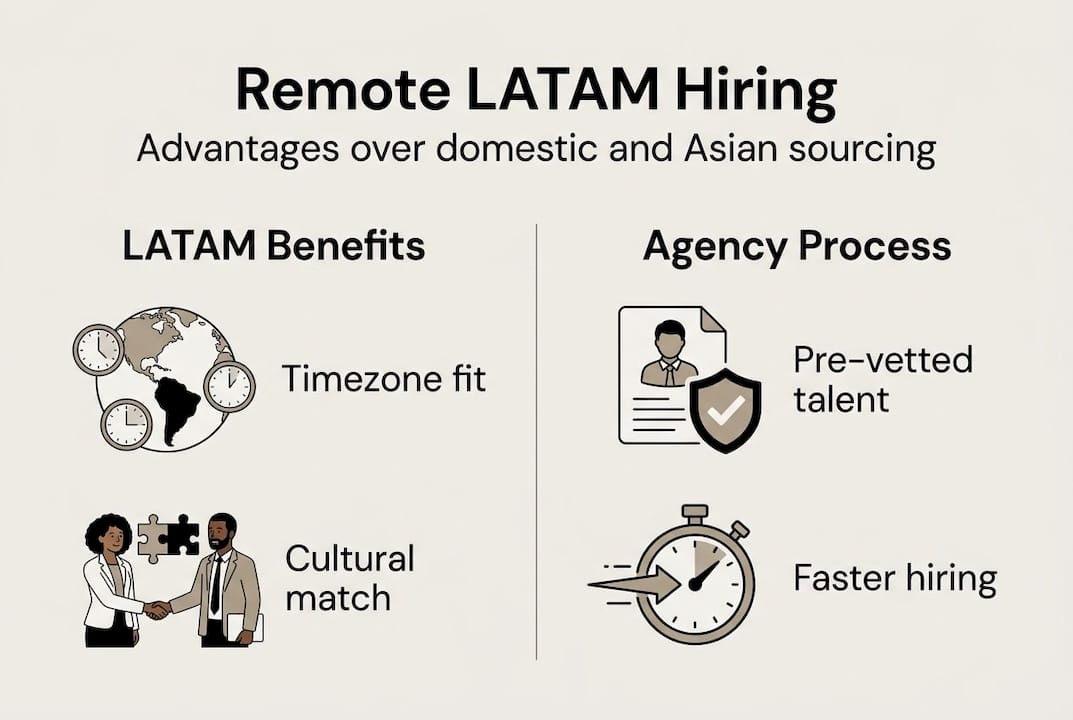
Beyond timezone fit, there’s a cultural alignment that’s harder to quantify but easy to feel. Latin American professionals are generally familiar with U.S. business culture, communication norms, and marketing trends. The mastering cultural differences challenge that agencies once feared has become manageable with the right onboarding systems.
Here’s a quick comparison to put it in perspective:
| Factor | Latin America | Southeast Asia | U.S. Domestic |
|---|---|---|---|
| Timezone overlap | High (ET/CT/PT) | Low (10-12hr gap) | Full |
| Cultural alignment | Strong | Moderate | Full |
| Cost vs. U.S. | 40-60% lower | 50-70% lower | Baseline |
| English proficiency | High | Varies | Native |
| Talent availability | Growing fast | Competitive | Tight |
The cost advantage is real, but it’s not the whole story. Agencies that optimize remote marketing teams with LATAM talent consistently report stronger retention numbers than those relying on domestic freelancers or offshore teams in Asia.
Key advantages that make LATAM stand out:
- Real-time collaboration with U.S. teams during standard business hours
- English fluency at a professional level across most major markets
- Growing talent pool in marketing, design, and digital roles
- Cultural familiarity with U.S. brands, platforms, and consumer behavior
The data backs this up. Remote teams show an 8% productivity boost compared to fully in-office teams, and vetted LATAM hires average over four years of tenure when placed through structured processes. Agencies that overcome marketing talent challenges with LATAM recruitment are building durable, high-performing teams, not just filling seats.
The key stages of an effective recruitment process breakdown
A structured recruitment process is what separates agencies that build great remote teams from those that cycle through hires every few months. Here’s how an effective LATAM recruitment process actually works, stage by stage.
- Define the role clearly. Vague job descriptions attract vague candidates. Before sourcing begins, nail down the exact skills, tools, timezone requirements, and performance benchmarks you need.
- Source proactively. Skip the generic job boards. A remote recruitment workflow built on headhunting reaches candidates who aren’t actively looking but are the best at what they do.
- Screen and assess. Structured interviews, skills tests, and English proficiency checks filter out mismatches early. This is where specialist partners add the most value.
- Compliance and contracts. Decide whether you’re hiring a contractor, using an Employer of Record, or bringing someone on directly. Each path has different legal and payment implications.
- Onboard with intention. A structured first 30 to 60 days sets the tone for long-term retention. Clear expectations, regular check-ins, and tool access from day one matter more than most agencies realize.
Pro Tip: Writing a detailed role definition before you start sourcing cuts your time-to-hire significantly and improves candidate quality. Agencies that skip this step often restart the process two or three times before getting it right.
Here’s how the main sourcing methodologies compare:
| Method | Speed | Cost | Compliance | Best for |
|---|---|---|---|---|
| Specialist agency | Fast (3 days) | Mid-range | Handled | Vetted, long-term hires |
| EOR (Deel/Remote) | Moderate | Higher | Full coverage | Full-time employees |
| Contractors (direct) | Fastest | Lowest | Minimal | Project-based work |
Using recruitment partners for remote hiring means you get pre-vetted candidates without spending weeks on sourcing. Specialist agencies source top 3 vetted candidates in as little as three days, compared to weeks on generic platforms like Upwork. An end-to-end HR management approach also ensures nothing falls through the cracks during onboarding and compliance.

Choosing the right hiring model: Agencies, EOR, or contractors?
Once you understand the process, the next decision is structural: how will you actually engage your LATAM hire? There are three main models, and each fits a different scenario.
Direct agency hire means a specialist recruiting firm sources, vets, and presents candidates, and you hire them directly. This works best for long-term roles where you want full control over the relationship and culture fit matters most.
Employer of Record (EOR) means a third-party company like Deel or Remote becomes the legal employer in the candidate’s country, handling payroll, taxes, and compliance on your behalf. It’s the cleanest option for full-time employment but adds $300 to $800 per month in fees.
Contractor model is the fastest and simplest option. You pay the individual directly through tools like Wise or Payoneer, and they operate as an independent professional. It’s ideal for project-based work or when you want to test a hire before committing.
| Model | Setup speed | Monthly cost | Legal protection | Best scenario |
|---|---|---|---|---|
| Specialist agency | 3-7 days | Placement fee | You manage | Long-term, vetted roles |
| EOR | 1-2 weeks | $300-800 extra | Full | Full-time, compliant hires |
| Contractor | 1-3 days | Lowest | Minimal | Short-term or trial periods |
Key considerations when choosing your model:
- Scale of commitment: Long-term, full-time roles benefit from EOR or direct agency placement
- Budget flexibility: Contractors offer the lowest upfront cost but less stability
- Legal exposure: Operating in multiple LATAM countries increases compliance complexity
- Retention goals: Structured engagement through talent headhunting in LATAM reduces churn significantly
Pro Tip: If you’re hiring across multiple Latin American countries at once, EOR is worth the extra monthly cost. It removes the legal complexity of managing different labor laws in Colombia, Mexico, and Argentina simultaneously. For lower turnover outcomes, the structure that EOR provides pays for itself.
Retention and productivity: Ensuring long-term success with remote LATAM hires
Hiring the right person is only half the equation. Keeping them, and getting their best work, requires intentional systems that most agencies underinvest in.
The data is clear: vetted remote hires average over four years of tenure when placed through structured processes, and remote teams show an 8% productivity advantage over fully in-office setups. But those numbers don’t happen automatically. They’re the result of deliberate retention practices.
“The agencies that get the best long-term results from LATAM hires aren’t the ones who pay the most. They’re the ones who communicate the clearest.”
What actually drives retention for remote LATAM professionals:
- Structured onboarding: A clear 30 to 60 day plan with defined milestones signals that you’re a serious employer worth staying with
- Regular feedback: Weekly or biweekly one-on-ones prevent small issues from becoming reasons to leave
- Career path visibility: LATAM professionals, like any skilled worker, want to know there’s room to grow
- Consistent communication: Slack, Loom, and async video updates keep remote hires connected to the team culture
- Fair, reliable payment: Timely payment through trusted platforms builds trust fast
Agencies that invest in employee retention solutions and pair them with strong onboarding consistently outperform those treating remote hires as interchangeable contractors. The LATAM success stories that stand out share one trait: the agency treated the hire as a long-term team member from day one, not a vendor.
The retention pitfalls to avoid are just as important. Unclear expectations, inconsistent feedback, and no path to advancement are the top three reasons skilled LATAM professionals leave roles that otherwise pay well. Fix those three things and your retention numbers will improve measurably.
Our take: What most agencies miss when optimizing their recruitment process
Most agencies treat hiring as a transaction. Post a role, review resumes, make an offer, move on. That approach works fine for commodity roles, but it fails badly when you’re trying to build a high-performing remote marketing team.
The agencies that truly win with LATAM talent understand that recruitment is a relationship, not a transaction. The best hires don’t come from job boards. They come from proactive outreach, genuine conversations, and a process that respects the candidate’s time and expertise.
What separates the top-performing agencies we’ve worked with is their commitment to continuous feedback loops. Not just structured onboarding, but regular, honest conversations about what’s working and what isn’t. That feedback culture is what turns a good hire into a four-year team member.
Another underrated strategy: building multi-country LATAM teams. When you source from Colombia, Mexico, and Argentina simultaneously, you get diversified skill sets, different cultural perspectives, and a team that’s more resilient to individual turnover.
Our final advice: revisit your recruitment and retention process every six months. Proven strategies for scaling LATAM teams evolve, and what worked in 2024 may need updating now. Agencies that audit their own processes stay ahead. Those that don’t quietly slip back into old habits.
Ready to optimize your LATAM recruitment process?
Building a high-performing remote team from Latin America doesn’t have to be complicated, but it does require the right partner and the right process. Remote Talent LATAM specializes in sourcing, vetting, and placing top-tier marketing professionals who are ready to work in your timezone, aligned with your culture, and committed to your agency’s growth.
Whether you’re hiring your first LATAM specialist or scaling a full remote team, we can help you move faster and smarter. Get started hiring LATAM talent today, explore how we source skilled remote LATAM pros through proactive headhunting, or read our full talent sourcing guide to understand the process from start to finish.
Frequently asked questions
How fast can I hire vetted LATAM talent for my agency?
With a specialist agency, top 3 vetted candidates can be sourced in as little as three days, provided you have a clear and detailed role definition ready from the start.
What’s the main advantage of hiring from Latin America compared to Asia or the U.S.?
Latin America offers better timezone and cultural fit for U.S. agencies than Southeast Asia, with no 12-hour gap, plus significantly lower costs than domestic hiring.
Which is better for compliance: contractors or using an Employer of Record?
An EOR is the stronger option for full-time employment and legal compliance, but it adds $300 to $800 per month in fees. Contractors are faster and simpler for project-based or trial engagements.
What can I do to improve retention with remote LATAM hires?
Structured onboarding, consistent feedback, and visible career paths are the biggest drivers. Turnover drops sharply when agencies invest in clear communication and treat remote hires as long-term team members from day one.
Recommended
- Build A Winning Remote Recruitment Workflow For LATAM Talent
- How To Build Remote Teams With Top LATAM Talent
- Talent Headhunting: Source Skilled Remote LATAM Pros Fast
- Streamline Agency Recruitment: Hire Top LATAM Talent Fast